
Osceola County Directory Collections
The firm local starting point is the 1921-1922 Kissimmee and St. Cloud, Florida City Directory and Osceola County Gazetteer. A descriptive volunteer transcription verifies the title, but the State Library catalog should confirm the copy, format, and publisher used. The wider State Library of Florida collection spans the early 1900s to the present across Florida and is arranged by city and then year. It does not prove that a Kissimmee or St. Cloud book exists for every year.
| Historical source | Verified span | Custodian | Use and access |
|---|---|---|---|
| Kissimmee/St. Cloud directory and county gazetteer | 1921-1922 | State Library and genealogy repositories; verify item | Resident, business, and community context |
| Florida city directories | Early 1900s to present, statewide shelf | State Library of Florida | Catalog online; volumes on-site |
| Kissimmee Sanborn maps | 1889, two sheets | Library of Congress | Free images showing structures, streets, and uses |
| Local books, photos, documents | Item-specific | Spence Research Center | Research request |
| Family histories and yearbooks | Limited, item-specific | Spence Research Center | Request or on-site review |
| Federal census | 1790-1950 public schedules | NARA and library resources | Households at ten-year intervals, with gaps |
No official public inventory found in the research proves a complete local publisher and year sequence. Treat that gap as a reason to ask the reference desk, not as permission to infer missing volumes. State Library staff can check Kissimmee and St. Cloud holdings through Archives@dos.myflorida.com or 850-245-6682.
Osceola County Directory Shelf Access
The State Library city-directory collection is the broadest verified shelf and the best place to confirm a volume before travel. Its catalog can be searched remotely, while the directories themselves are described as on-site resources. Ask for a city, year range, title, and format. A reference reply can prevent a searcher from treating the statewide early-1900s-to-present span as a continuous Osceola County run.
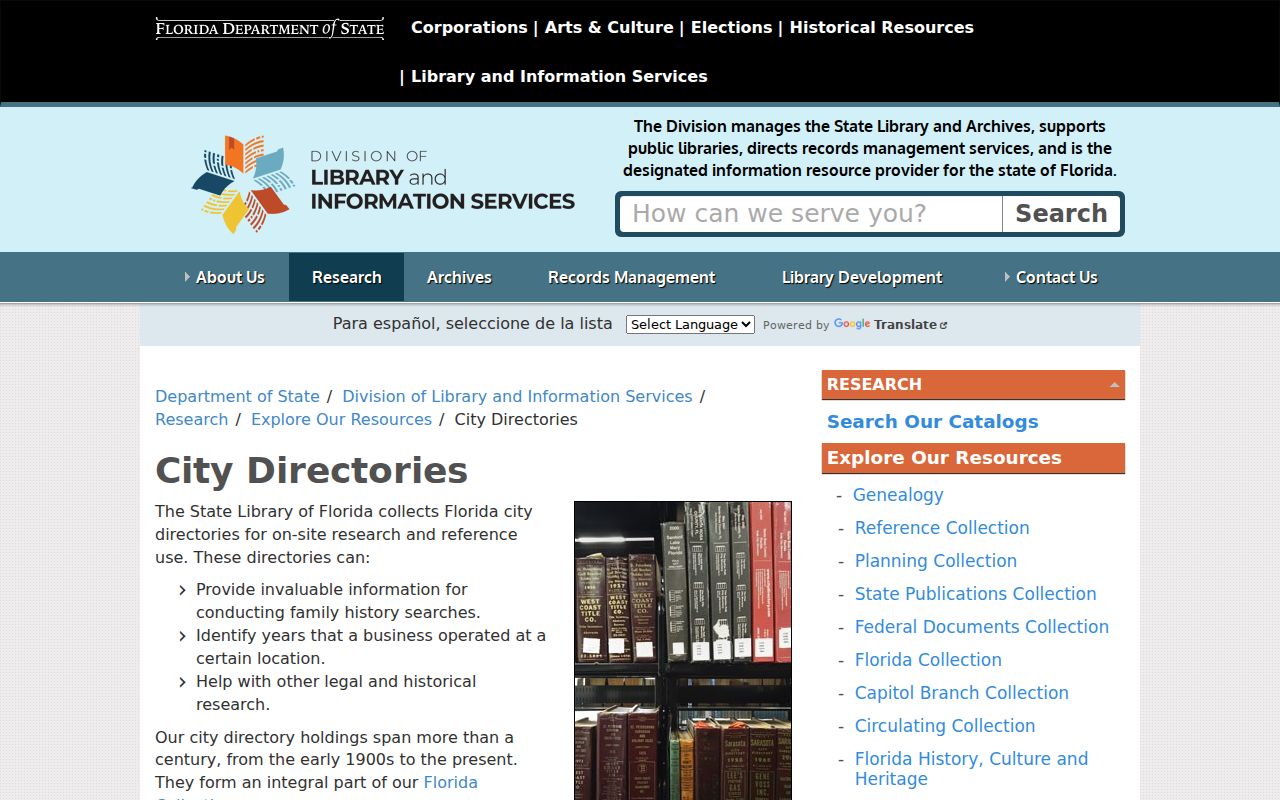
The collection page shows why catalog confirmation is part of the city directory process: the shelf is grouped across Florida, and local issues must be identified within that larger set. If the catalog result is unclear, use the reference email or phone rather than guessing at a publisher or year.
Reading Osceola County Directory Entries
A typical entry in a book of this period may give a surname, first name or initial, spouse notation, work or trade, employer, and residence. A business section may instead list the business type and address, while the gazetteer may name places and public officials. These are typical conventions, not a transcription of an open local page image, which the research did not locate.
| Name line | Surname, given name or initial, sometimes with spouse notation |
|---|---|
| Work line | Occupation, trade, or employer when printed |
| Residence | House number and street, subject to that edition's abbreviations |
| Business listing | Business name or class and its listed address |
| Widow notation | A term such as “wid,” checked against the book's key |
Copy punctuation and abbreviations exactly before interpreting them. “H” often means home or householder, “r” often means resides or rooms, and “wid” often means widow, but only the key printed in that edition controls. Do not assume a directory proves ownership, every household member, or continuous residence.
- Criss-cross directory
- A later address-first arrangement used to move from a street location to a listed name.
- Householder index
- An index organized around the person identified as householder rather than every person at the address.
- Abbreviation key
- The edition's own guide to short forms for residence, work, status, and street terms.
Hart Memorial Genealogy Help
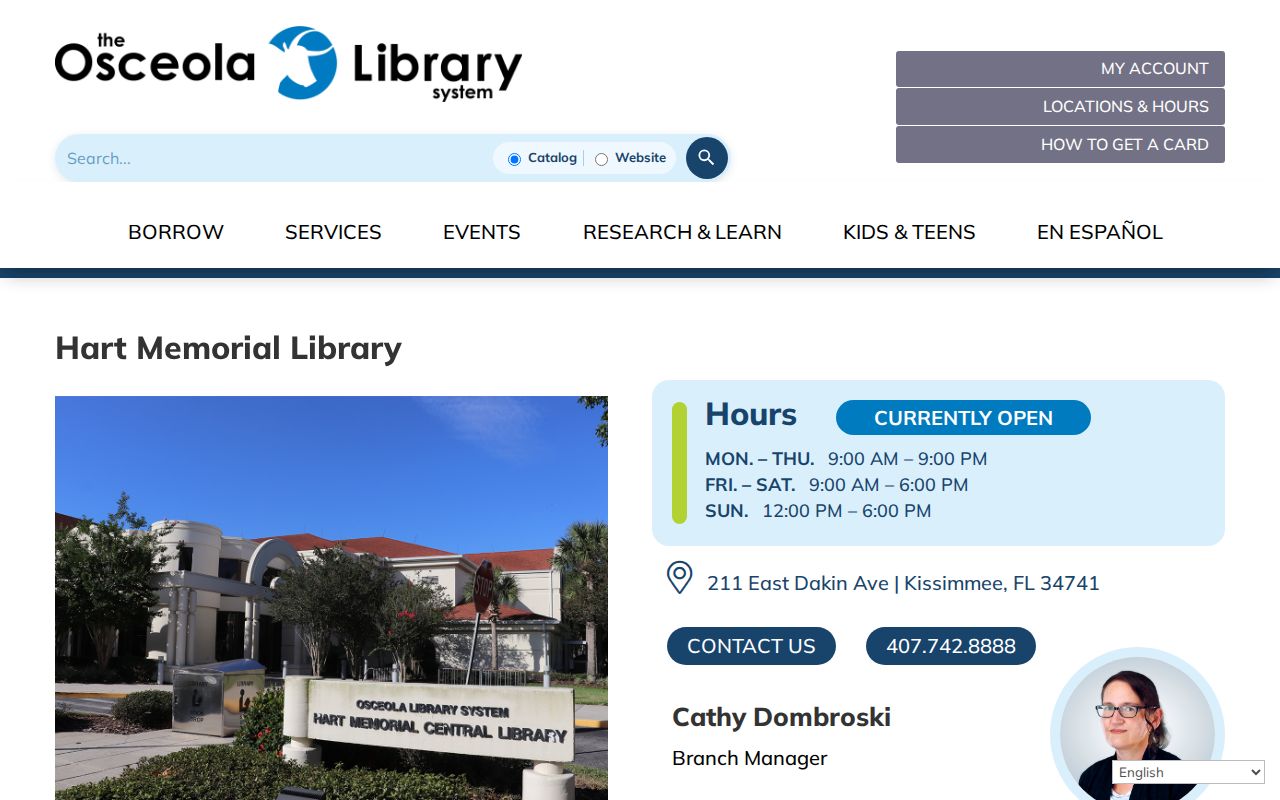
Hart Memorial Library is the central local-history starting point at 211 E. Dakin Avenue in Kissimmee. Its posted hours are Monday through Thursday, 9 a.m. to 9 p.m.; Friday and Saturday, 9 a.m. to 6 p.m.; and Sunday, noon to 6 p.m. The branch phone is 407-742-8888. Staff can help confirm call numbers and explain whether a genealogy database is available from home, with a library card, or only inside a branch.
The Osceola Library InfoGuides gateway includes Genealogy & Florida History resources. Ask about city or reverse directories, telephone books, historic newspapers, yearbooks, obituary files, and the combined 1921-22 title. License terms vary, so a database named on a guide should not be assumed to work from every device.
The guide is a bridge to local and licensed sources, not a promise that every directory year is digitized. When an online title list stops short, call the branch and describe the surname, place, year range, and old address.
Osceola County Yearbook Clues
The Spence Research Center holds Osceola and Florida books, photographs, documents, a limited family-history collection, and local yearbooks. That mix is useful when a city directory yields a student, school, family name, or unexplained gap. A request should state spelling variants, the community, an approximate date, the school if known, and the exact address copied from another record.
Osceola History was founded in 1949, and its archive connects people with the county's built setting in ways a modern tax roll cannot. The Hart Memorial branch page also gives current local contact details.
Together, the branch and research center form the fallback chain when a title is not openly searchable: check the guide, ask library staff, then send a focused archival request.
Osceola County City Directory Timeline
Local record dates provide a careful frame without filling unverified gaps. Osceola County was formed in 1887. Two public-domain Kissimmee Sanborn sheets follow in 1889. Carrie S. Hart donated library land in 1910, residents funded the Hart Memorial building in 1914, and the verified combined city directory and gazetteer appeared in 1921-22. Osceola History dates to 1949, and independent county library operations began in 1989.
- 1887: Osceola County formed from parts of Orange and Brevard Counties.
- 1889: Two Kissimmee Sanborn sheets map the early built core.
- 1910 and 1914: Hart land donation and funded library building.
- 1921-22: Verified Kissimmee/St. Cloud directory and county gazetteer.
- 1949 and 1989: Osceola History founded; county library system begins independent operation.
This timeline does not establish first or last directory publication years. It marks only facts supported by the research and shows where a directory find can connect to a map, archive, or library collection.
Kissimmee's Two Sanborn Sheets
The 1889 Library of Congress Sanborn edition has two downloadable public-domain sheets. It records building outlines, construction, use, street labels, and fire infrastructure, but not resident names. Pair a mapped structure with a directory, deed, or census before linking a person to it. A shifted street label or number can often be tested through intersections and the parcel's legal description.
The sheets date to two years after the county's formation, making them a rare visual check on early Kissimmee. They also expose a hard limit: a building footprint may survive on a map even when the name sought appears only in a directory, newspaper, church record, deed, or census.
Trace Osceola County Directory Families
Start with a known year and address, then search the alphabetical section for spelling, spouse, occupation, and residence. If the volume has a street section, use it only after confirming that section exists. Copy the abbreviation key and citation, move one issue at a time, and note a person's first and last appearance. The Osceola County resident lookup can help test a later identity.
- Record the entry exactly, including initials, spouse notation, occupation, and short forms.
- Check the prior and next available issues, without assuming the collection is annual.
- Pair the 1921-22 entry with the 1920 and 1930 federal censuses.
- Use deeds and tax records to separate a listed resident from a property owner.
- When a person vanishes, test marriage, death, obituary, probate, and move evidence.
A missing entry can mean a move, death, omission, rural location, changed name, or simple canvassing gap. Older directories may shorten given names and omit many women except as spouses or widows. Search compound surnames together and separately, and confirm every inferred relationship in another record.
Before Osceola County Directories
Osceola County did not exist before 1887. A person or parcel in the same modern place may therefore appear in Orange or Brevard County custody for an earlier event. Search by the place and date that governed when the record was made, not solely by today's county line. County deeds and probate after formation move into Osceola custody, while federal land and state series may remain elsewhere.
The destroyed 1890 population schedules make this boundary issue more important. For that period, bridge the 1880 and 1900 censuses with deeds, tax lists, church and vital records, maps, and newspapers. In rural south Osceola, section-township-range and historic county maps can work better than a street-first search.